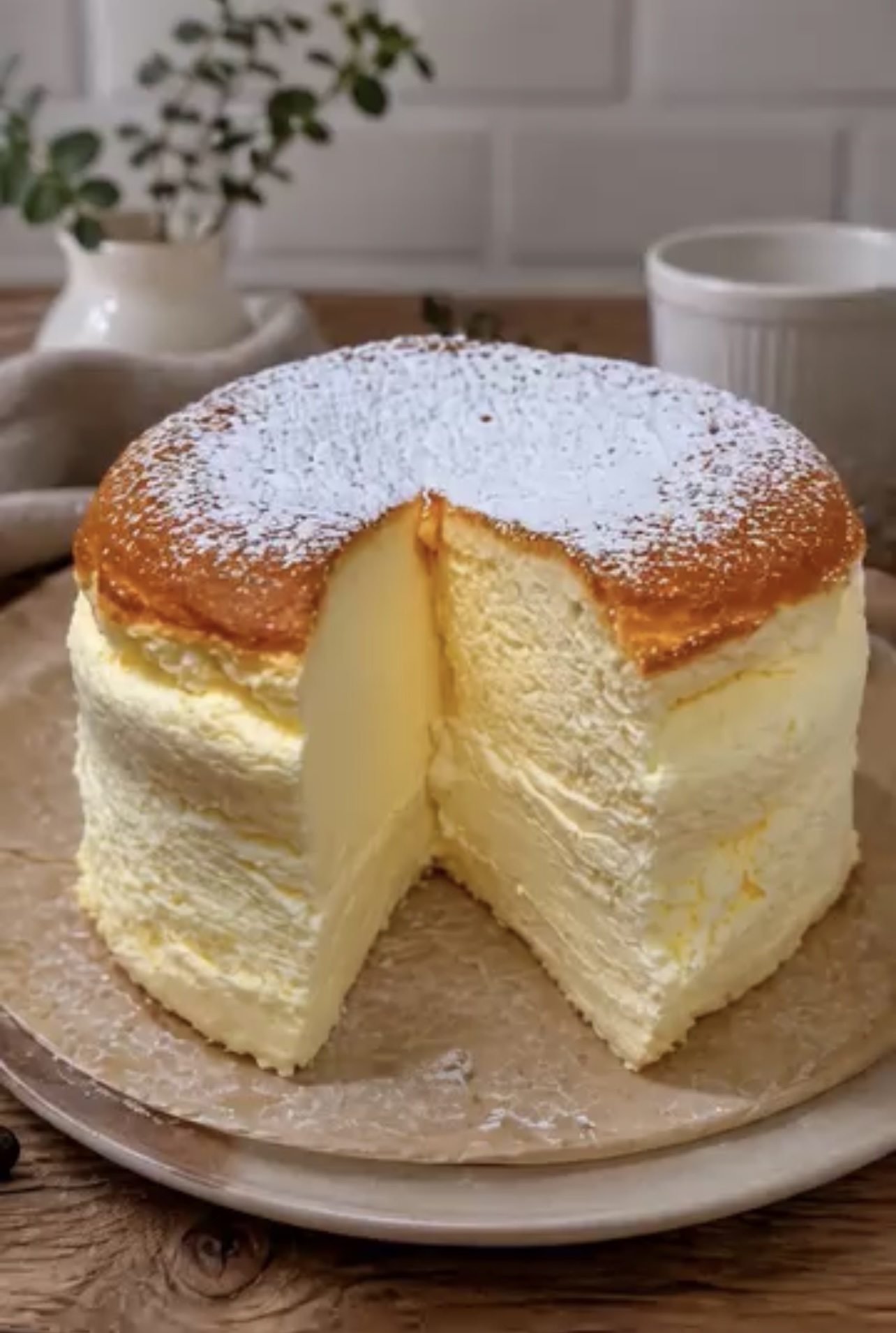
This Japanese Soufflé Cheesecake is wonderfully light, fluffy, and delicate, with a soft, cloud-like texture and a gentle cream cheese flavor. Unlike traditional New York cheesecake, this Japanese-style dessert combines a creamy cheese mixture with a carefully whipped meringue to create a cake that rises beautifully in the oven.
Made with simple ingredients like cream cheese, eggs, butter, and milk, this homemade cheesecake is perfect for afternoon tea, special occasions, or whenever you want an elegant dessert that melts in your mouth.
📋 Recipe Overview
| Detail | Information |
| Prep Time | 25 minutes |
| Cook Time | 60–70 minutes |
| Cooling Time | 1 hour |
| Total Time | Approximately 2 hours 30 minutes |
| Servings | 6–8 |
| Cake Pan | 6-inch round pan |
| Oven Temperature | 320°F (160°C), then 285°F (140°C) |
| Difficulty | Intermediate |
| Texture | Light, airy, soft, and fluffy |
❤️ Why You’ll Love This Recipe
- Light and fluffy texture: Whipped egg whites give the cheesecake its signature soufflé-like consistency.
- Delicate sweetness: Cream cheese and vanilla create a balanced flavor without making the cake overly rich.
- Beautiful homemade dessert: Its golden top and soft interior make it perfect for serving to guests.
- Simple ingredients: You only need a handful of everyday baking ingredients.
- Perfect for special occasions: Serve it for birthdays, afternoon tea, holidays, or family gatherings.
- Delicious chilled or slightly warm: Enjoy its delicate texture after cooling or refrigerate it for a firmer cheesecake.
🛒 Ingredients
Cream Cheese Mixture
| Ingredient | Amount |
| Cream cheese, softened | 140 g (5 oz) |
| Unsalted butter | 40 g (about 3 tbsp) |
| Whole milk | 50 ml (3½ tbsp) |
| Egg yolks | 3 large |
| Vanilla extract | 1 tsp |
| Lemon juice | 1 tsp, optional |
| Cake flour | 30 g (¼ cup) |
Meringue
| Ingredient | Amount |
| Egg whites | 3 large |
| Granulated sugar | 60 g (¼ cup + 1 tbsp) |
| Cream of tartar | ¼ tsp, optional |
Important: Separate the eggs while cold, then let the yolks and whites come to room temperature. Make sure the egg whites contain no traces of yolk or grease so they can whip properly.
Optional Toppings
- Powdered sugar for dusting
- Fresh strawberries or blueberries
- A few lemon zest curls
- Fresh mint leaves
👩🍳 Step-by-Step Instructions
Step 1: Prepare the Cake Pan
- Preheat your oven to 320°F (160°C).
- Line the bottom and sides of a 6-inch round cake pan with parchment paper.
- If using a springform pan, wrap the outside securely with aluminum foil to help prevent water from entering during baking.
- Bring a kettle of water to a boil for the water bath.
Tip: Use parchment paper that extends slightly above the rim because the cheesecake may rise during baking.
Step 2: Melt the Cream Cheese Mixture
- Place the cream cheese, butter, and milk in a heatproof bowl.
- Set the bowl over a saucepan of gently simmering water, making sure the bottom of the bowl does not touch the water.
- Stir gently until the mixture becomes smooth and creamy.
- Remove the bowl from the heat and allow the mixture to cool slightly.
- Whisk in the egg yolks, vanilla extract, and optional lemon juice until smooth.
Avoid adding the egg yolks while the mixture is very hot, as this could cook them prematurely.
Step 3: Add the Cake Flour
- Sift the cake flour into the cream cheese mixture.
- Whisk gently until no dry flour remains.
- If necessary, strain the mixture through a fine-mesh sieve to remove lumps.
- Set aside while preparing the meringue.
The mixture should be smooth, pourable, and free of large lumps.
Step 4: Whip the Egg Whites
- Place the egg whites in a completely clean, dry mixing bowl.
- Add the optional cream of tartar.
- Beat with an electric mixer on medium speed until the whites become foamy.
- Gradually add the granulated sugar, a little at a time.
- Increase the speed to medium-high and beat until the whites form glossy medium-stiff peaks.
When you lift the whisk, the meringue should hold its shape, with the tip bending slightly.
Avoid overbeating. Dry, grainy egg whites are difficult to incorporate evenly and can make the cheesecake crack or collapse.
Step 5: Fold the Meringue Into the Batter
- Add one-third of the whipped egg whites to the cream cheese mixture.
- Gently whisk this first portion into the batter to lighten it.
- Add the remaining meringue in two batches.
- Use a spatula to fold from the bottom of the bowl upward, rotating the bowl as you work.
- Stop folding as soon as the batter is evenly combined.
Do not stir vigorously. Preserving the air in the meringue is essential for achieving the characteristic light texture.
Step 6: Fill the Cake Pan
- Pour the batter into the prepared cake pan.
- Gently tap the pan against the counter once or twice to release large air pockets.
- Place the cake pan inside a larger roasting pan.
- Carefully pour hot water into the roasting pan until it reaches approximately halfway up the sides of the cake pan.
The water bath helps the cheesecake bake gently and evenly, reducing the risk of a dry texture or deep cracks.
Step 7: Bake the Cheesecake
Bake using two temperature stages:
- Bake at 320°F (160°C) for 20 minutes.
- Reduce the oven temperature to 285°F (140°C) without opening the oven door.
- Continue baking for another 40–50 minutes.
The total baking time will generally be 60–70 minutes, although ovens and pans vary.
The cheesecake is ready when the top is lightly golden, the sides appear set, and the center has a gentle jiggle rather than looking liquid.
If the top browns too quickly, reduce the oven temperature slightly.
Step 8: Cool Gradually
- Turn off the oven when the cheesecake is baked.
- Leave the oven door slightly open and allow the cake to rest inside for approximately 15–20 minutes.
- Remove the cake from the water bath and carefully take off any foil.
- Let it cool in the pan for another 30–40 minutes.
- Once sufficiently cool, remove it from the pan and peel away the parchment paper.
Some shrinkage is normal as the cheesecake cools. Gradual cooling helps reduce sudden temperature changes that can cause excessive shrinking.
Step 9: Chill and Serve
You can serve the cheesecake after it has cooled, or refrigerate it for 2–3 hours for a firmer texture.
Dust the top with powdered sugar just before serving, if desired.
For clean slices, use a sharp knife dipped in warm water and wiped dry between cuts.
⭐ Best Tips for a Perfect Japanese Cheesecake
- Use room-temperature ingredients: This helps the cream cheese mixture become smooth and makes folding easier.
- Keep the mixing bowl grease-free: Even a small amount of fat can prevent egg whites from whipping properly.
- Whip to medium-stiff peaks: The meringue should be glossy and stable without becoming dry.
- Fold gently: Too much mixing removes the air needed for a fluffy cake.
- Use a water bath: Gentle, moist heat helps the cheesecake bake evenly.
- Avoid opening the oven early: Sudden temperature changes may cause the cake to deflate.
- Check your pan size: A smaller or larger pan can change the cake’s height and baking time.
- Cool slowly: A gradual temperature change helps maintain the cake’s structure.
🧈 Best Ingredient Options
| Ingredient | Recommended Option | Why It Works |
| Cream cheese | Full-fat block cream cheese | Provides a creamy flavor and stable texture |
| Butter | Unsalted butter | Adds richness without extra salt |
| Milk | Whole milk | Creates a smooth, tender batter |
| Flour | Cake flour | Produces a delicate crumb |
| Sugar | Fine granulated sugar | Dissolves easily into the meringue |
| Vanilla | Pure vanilla extract | Adds a warm, sweet aroma |
| Lemon juice | Freshly squeezed lemon juice | Adds a subtle brightness |
Can you use all-purpose flour? Yes. Cake flour is preferable, but all-purpose flour can work in a pinch. The texture may be slightly less delicate.
🍓 Recipe Variations
1. Lemon Japanese Cheesecake
Add 1 teaspoon of finely grated lemon zest to the cream cheese mixture for a fresh citrus flavor.
2. Vanilla Bean Cheesecake
Replace the vanilla extract with vanilla bean paste for a more pronounced vanilla aroma.
3. Matcha Japanese Cheesecake
Sift 1 teaspoon of matcha powder with the cake flour for a gentle green tea flavor.
4. Strawberry Cheesecake
Serve each slice with fresh strawberries and a small spoonful of strawberry sauce.
5. Chocolate Japanese Cheesecake
For a chocolate variation, use a tested chocolate Japanese cheesecake recipe with adjusted flour, sugar, and fat proportions. Simply adding melted chocolate to this batter can change its structure.
🍽️ What to Serve With Japanese Soufflé Cheesecake
This delicate dessert pairs beautifully with:
- Fresh strawberries, raspberries, or blueberries
- A light dusting of powdered sugar
- Homemade strawberry or raspberry sauce
- A cup of green tea
- Black coffee or espresso
- Lightly sweetened whipped cream
- Fresh lemon or orange zest
For a simple afternoon tea, serve thin slices with fresh fruit and hot tea.
⏰ Make-Ahead Instructions
Japanese soufflé cheesecake can be prepared ahead of time.
- The day before: Bake the cheesecake, cool it completely, cover, and refrigerate.
- A few hours before serving: Chill the cake until firm enough to slice cleanly.
- Just before serving: Add powdered sugar, fresh berries, or other toppings.
For the best texture, avoid decorating with wet fruit too far in advance, as the moisture can soften the surface.
🧊 Storage
Store leftover cheesecake in an airtight container in the refrigerator for up to 3 days.
Because the cake contains cream cheese and eggs, refrigerate it promptly after cooling. Do not leave it at room temperature for more than 2 hours, or 1 hour in temperatures above 90°F (32°C).
🔥 Reheating
Japanese soufflé cheesecake is usually enjoyed chilled or at room temperature.
If you prefer a softer texture, remove a slice from the refrigerator and let it stand for approximately 10–15 minutes before serving.
Avoid prolonged microwave heating, which can make the texture rubbery or cause the cake to become unevenly warm.
❄️ Freezing
You can freeze Japanese soufflé cheesecake, although freezing may slightly change its delicate texture.
- Allow the cheesecake to cool completely.
- Slice it into individual portions.
- Wrap each slice tightly in plastic wrap.
- Place the wrapped slices in a freezer-safe container.
- Freeze for up to 1 month for best quality.
- Thaw overnight in the refrigerator before serving.
Avoid freezing the cake while it is still warm, as trapped condensation can affect its texture.
⚠️ Common Mistakes to Avoid
1. Overbeating the Egg Whites
Very stiff, dry meringue is difficult to fold into the batter and can create an uneven texture.
Solution: Stop beating when the peaks are glossy and hold their shape with a slight bend.
2. Deflating the Meringue
Vigorous stirring removes the air that makes the cake rise.
Solution: Fold slowly with a spatula, using gentle upward movements.
3. Using Cold Cream Cheese
Cold cream cheese can form lumps that are difficult to remove.
Solution: Let it soften at room temperature before mixing.
4. Skipping the Water Bath
Without gentle, moist heat, the outside may cook too quickly while the center remains underbaked.
Solution: Use a roasting pan filled with hot water and protect the cake pan against leaks.
5. Opening the Oven Door Too Early
A sudden temperature drop can make the cheesecake shrink or collapse.
Solution: Keep the oven closed during the initial baking stages.
6. Removing the Cake Too Soon
A cheesecake that has not finished baking may collapse or remain wet in the center.
Solution: Look for a set surface and a gentle center jiggle, and allow enough time for gradual cooling.
🥗 Nutrition Estimate
The following values are approximate and will vary depending on the cream cheese brand and portion size.
| Nutrient | Per Serving |
| Calories | 160–200 kcal |
| Protein | 4–5 g |
| Carbohydrates | 15–20 g |
| Fat | 9–12 g |
| Saturated Fat | 5–7 g |
| Sugar | 10–14 g |
| Sodium | 100–160 mg |
Estimates assume the cake is divided into 8 servings and do not include optional toppings.
❓ Frequently Asked Questions
Why did my Japanese cheesecake collapse?
A little shrinking is normal. Significant collapse can happen if the meringue was under-whipped, over-whipped, deflated during folding, or if the cake was underbaked. Sudden cooling can also contribute.
Should Japanese cheesecake be jiggly when it comes out of the oven?
Yes, the center should have a gentle jiggle, but it should not look liquid. The cake will continue to settle as it cools.
Can I make this recipe without a water bath?
A water bath is strongly recommended because it helps the cheesecake bake evenly and remain moist. Baking without one increases the risk of cracks, dryness, and uneven rising.
Why is my cheesecake dense instead of fluffy?
The most common reasons are deflated egg whites, overmixing, or a meringue that was not whipped to the correct consistency.
Can I use a 7-inch pan instead of a 6-inch pan?
Yes, but the cheesecake will be shorter and may bake faster. Begin checking for doneness earlier than the recipe suggests.
Is Japanese soufflé cheesecake the same as regular cheesecake?
No. Traditional cheesecake is usually dense and rich, while Japanese soufflé cheesecake uses whipped egg whites to create a lighter, airier texture.
Can I make Japanese cheesecake without cake flour?
Yes. All-purpose flour can be substituted, although the texture may be slightly less tender. Measure carefully to avoid adding too much flour.
Should I refrigerate Japanese cheesecake overnight?
Overnight refrigeration is optional, but it helps the cake become firmer and makes slicing easier. Allow it to cool completely before covering and refrigerating.
🍰 Final Thoughts
Japanese Soufflé Cheesecake is a beautiful homemade dessert that combines the creamy richness of cheesecake with the airy softness of a soufflé. Although the technique requires a little care, using room-temperature ingredients, folding the meringue gently, baking in a water bath, and cooling the cake gradually will help you achieve the best results.
Serve it with fresh berries, a dusting of powdered sugar, or a cup of tea for an elegant dessert that feels special without requiring complicated ingredients.